Choose keywords based on intent, not search volume.




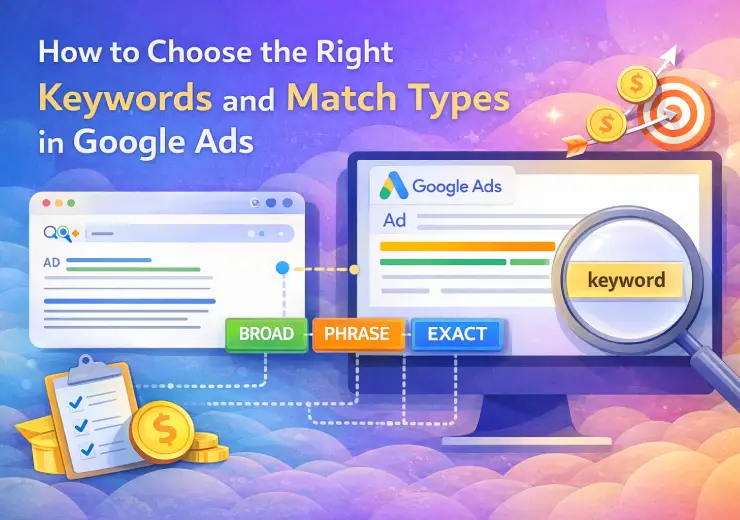
Selecting the right keywords and match settings is not just an optimisation question – it’s a strategic decision. They determine not only which searches you pay for, but more importantly, which data the Google Ads algorithm uses to optimise your campaigns.
A poor choice almost always leads to the same pattern: budget is spent on searches without purchase or lead intent, conversion costs increase, and campaigns become increasingly unpredictable.
In this article, you will learn how to select keywords and match types based on goals, data reliability, and control rather than search volume or guesswork. You’ll gain a clear decision framework that helps determine when an exact phrase, or a broad match, is appropriate, which keywords strengthen the algorithm, and which ones contaminate it with poor signals. Instead of generic advice, you will find practical decisions you can apply directly in your Google Ads account.
Businesses running paid campaigns often combine strong keyword strategies with professional Google Ads campaign management to ensure that budgets are used efficiently and campaigns remain scalable.
Choosing keywords and match settings should not start with search volume or Google’s automated recommendations. Instead, it begins with three critical conditions: campaign goals, data reliability, and the level of control you require.
If one of these elements is missing, the algorithm will optimise for the wrong signals – no matter how well structured the campaign appears.
Use this decision framework as a starting point.
If so, choose keywords with clear purchase or decision intent and match types that allow control over the search queries included in the campaign. Broad interpretation without value-based signals almost always leads to wasted budget.
Only when conversions are tracked consistently and accurately should you allow broader match types. With incomplete or unreliable data, broad match typically increases noise rather than reach.
In the early stages of a campaign or during a restructuring phase, control is more important than scale. This requires tighter match types. Once performance becomes predictable, you can gradually allow broader interpretations.
This framework ensures you select match types based on campaign phase, data quality, and business goals rather than assumptions about performance.

Choose keywords based on intent, not search volume.
Match types are a control decision. Less reliable data requires tighter match types.
Broad match only works well when campaigns optimise for value.
Scale campaigns only when user behaviour and conversions are stable.

Not every keyword is suitable for training the Google Ads algorithm. The key factor is not search volume, but the predictability of user intent.
What problem is the user trying to solve
Which offer or landing page provides the correct solution
Whether conversions from this keyword are consistent in quality
The search query indicates an active purchase or enquiry intent
The relevant service or landing page can be clearly defined
Conversions occur repeatedly and with similar values
Broad or ambiguous intent
Conversions with inconsistent quality
High traffic but little strategic value for optimisation
In practice, this means selecting fewer but more precise keywords rather than a large set that forces the algorithm to guess which traffic is valuable.
Match types determine how Google interprets your keywords and how much decision-making power you give to the algorithm. The question is therefore not which match type is “better”, but which level of interpretation is appropriate based on your data.
An exact match is used when maximum control is required. It is ideal for campaigns with clear purchase or enquiry intent and limited data volume.
Although an exact match is no longer strictly literal, Google still limits the variation to close intent-based queries.
This means ads appear only when searches closely match the chosen keyword.
Phrase match is often the safest default option.
It allows Google to include relevant variations while keeping the core intent intact. Phrase match performs well when you have sufficient conversion data but still want control over search terms and cost per conversion.
The broad match modifier sits between phrase and broad match. It ensures specific keywords appear in the search query while allowing additional variations.
+holiday +Spain
Both terms must appear in the search query, though the order may vary.
This approach allows the discovery of new keywords while maintaining reasonable control over relevance.
Broad match should not be the starting point of a campaign, but rather a scaling tool.
It is only advisable when conversion tracking is reliable, and campaigns are optimised for value rather than traffic volume.
Without clear value signals, broad match increases the likelihood that Google optimises for clicks rather than profitable conversions.
When using broader match types, negative keywords become essential.
They help exclude irrelevant search queries, reduce wasted budget, and improve campaign quality scores.
Negative keywords allow advertisers to maintain the right balance between reach and relevance.
Beyond match types, Google Ads Customer Match is a powerful optimisation tool.
With Customer Match, advertisers can upload customer data such as email addresses or phone numbers to create highly targeted audiences.
Google uses this information to find users similar to your existing customers and display personalised ads across platforms, including Search, Gmail, YouTube, and the Display Network.
Uploading customer data through Customer Match must comply with privacy regulations.
Google requires the data to be hashed using the SHA256 algorithm. Accounts must also meet certain requirements, such as customer consent and proper data handling practices.
Sensitive information should be processed carefully, and only necessary fields should be included in uploaded files.
Start with tighter match types, such as exact and phrase match
Use broader match options gradually to discover new keywords
Apply broad match only when conversion data is reliable
Always use negative keywords to prevent wasted budget
Use Customer Match to reach valuable existing and similar audiences

Use this checklist when reviewing your search terms report.
Avoid making decisions based on a single click. Look for patterns across multiple impressions and clicks.
Evaluate not only conversions but also their consistency and value.
Recurring converting queries should be added as exact match keywords to improve predictability.
Irrelevant queries should be excluded using negative keywords.
Avoid overly aggressive exclusions that may block valuable variations.
This structured approach ensures decisions are based on data rather than intuition.
If your campaigns are generating traffic but not delivering consistent leads or revenue, your keyword and match type strategy may need improvement.
At ANA DIGITAL MEDIA, we help businesses build high-performance advertising campaigns using data-driven strategies.
Keyword strategy and search intent analysis
Conversion tracking and optimisation
Campaign structure and bidding strategies
Scalable Google Ads advertising campaigns
Fill out the lead form below to request a free Google Ads analysis and discover how your campaigns can perform better.
Scaling only works when Google Ads reacts predictably to additional budget.
Keywords consistently reflect the same user intent
Conversions are repeatable and similar in quality
Budget increases do not cause a sudden drop in performance
Match types generate relevant search queries without constant manual corrections
Conversion data clearly guides optimisation toward value
If any of these conditions are missing, scaling may simply multiply inefficiencies already present in your campaign structure.

Many Google Ads issues are caused not by a lack of optimisation, but by incorrect initial decisions.
Starting with a broad match without reliable conversion data
Choosing keywords based on search volume instead of intent
Adding too many keywords without a clear structure
Using phrase and exact match simultaneously without defined roles
Applying negative keywords either too late or too aggressively
Changing match types without analysing search terms or bidding strategies
These mistakes may appear harmless initially, but they often lead to significant inefficiencies when budgets increase.
Choosing the right keywords and match types in Google Ads is not a one-time action but an ongoing strategic process.
which searches you pay for
which user intent enters your campaign
and which signals the algorithm uses for optimisation
The safest approach is to begin with keywords that show clear commercial intent combined with tighter match types such as exact and phrase match. This ensures reliable data and prevents the algorithm from learning from irrelevant signals.
Once results become stable and conversion data improves, broader match types can be introduced to scale campaigns without increasing wasted spend.
In summary, match types should be selected based on how much interpretation your campaign data can support. This approach allows advertisers to maintain control, target relevant audiences, and gradually scale profitable campaigns.
By continuously refining keyword strategies, Customer Match audiences, and negative keywords, advertisers can maximise the value of existing campaigns and reach new potential customers with personalised advertising across Google platforms.


Let our experts turn your goals into real results.
ⓒ Copyright 2026 . All Rights Reserved By ANA Digital Media