
Preloader Logo
ANA Digital Media Logo
Breadcrumb Elements 1 Breadcrumb Elements 2

How do you effectively use Demand Gen for B2B lead generation?

Home How do you effectively use Demand Gen for B2B lead generation?
How do you effectively use Demand Gen for B2B lead generation?

I hope you enjoy reading this article. If you need support with SEO , Google Ads , Facebook Ads, or Landing Pages, click on the link.

Demand Gen can be an extremely powerful channel for B2B lead generation, but only if you deploy it with the right expectations. This is not a "Search alternative" with which you immediately bring in hot demo requests. Demand Gen is intended to create demand among people who are not yet actively searching, but who do belong to your ideal target group.

In practice, we see that the channel works particularly well for B2B companies with a clear proposition, a recognisable problem in the market, and a lead process that goes beyond just a form.

In this article, you will learn concretely when Demand Gen makes sense for B2B, which prerequisites you must have in order first, how to set up campaigns without wasting budget, and how to prevent Google from optimising for leads that sales ultimately never follows up.

What is Demand Gen, and when is it smart for B2B?

Demand Gen is a Google Ads campaign type with which you reach B2B target groups on YouTube, Gmail, and Discover, without them actively searching. The goal is not "scoring directly," but creating demand and subsequently bringing in qualitative leads via remarketing and Search.

Demand Gen is particularly smart for B2B if you are in one of these situations:

You sell a service or product with a long decision cycle (e.g., 1–6 months). Your target group searches a little for your solution, but does recognise the problem. You are dependent on referrals or inbound and want an extra predictable lead source. Search is already active, but you notice that you are hitting a ceiling in volume. You want to grow in a niche where competitors are bidding aggressively on the same keywords.

Demand Gen is usually not a good choice if your tracking is not yet correct, your sales process is weak, or if your offer only converts on "buy now" intent. In that case, you will mainly get many clicks, but few leads that are truly sales-worthy.

Key Takeaways

Demand Gen is not a Search alternative, but a demand-creation channel that, in B2B, primarily works if you combine it with remarketing and search. Lead quality stands above CPL: Demand Gen only performs predictably if you optimise for sales-worthy conversions (ideally via offline conversion tracking). Structure and separation are crucial: split prospecting and remarketing, otherwise your performance seems better than it really is. Creatives and landing pages determine success: B2B Demand Gen wins with problem recognition + proof, not with "pretty branding visuals."

Which prerequisites must you have in order first?

Demand Gen only works well if Google receives clear signals about what constitutes a good B2B lead for you. If you do not set that up correctly, Demand Gen will optimise for the easiest conversions: people who click quickly, fill in a form quickly, and often do not fit your target group.

Therefore, before you go live, ensure that you have these 3 prerequisites in order:

Check Icon

You do not measure "leads," but lead quality: A completed form is not a success if sales can do nothing with it. Set up your conversions in such a way that you make a minimum distinction between: contact form (low), demo request/intake (high), quote request (high), applications/spam (exclude)

Check Icon

You can link conversions back to Google Ads (offline conversions): If you use a CRM (HubSpot, Leadbrix, Salesforce, Pipedrive), you ideally want to send back: SQL (sales qualified lead), deal created, deal won (possibly with revenue value). This is the fastest way to let Demand Gen learn on quality instead of volume.

Check Icon

Your landing page and offer are 'Demand Gen-proof': Demand Gen traffic is colder than Search. That means your page: must make it clear within 5 seconds who it is for, must immediately recognise the problem, must show proof (cases, clients, results) and must offer a low-threshold next step (not just "contact us")

If one of these points is missing, you will almost always see the same pattern: high reach, many clicks, decent CPL… and ultimately disappointment at sales.

How do you build a Demand Gen campaign that yields leads (and not just clicks)?

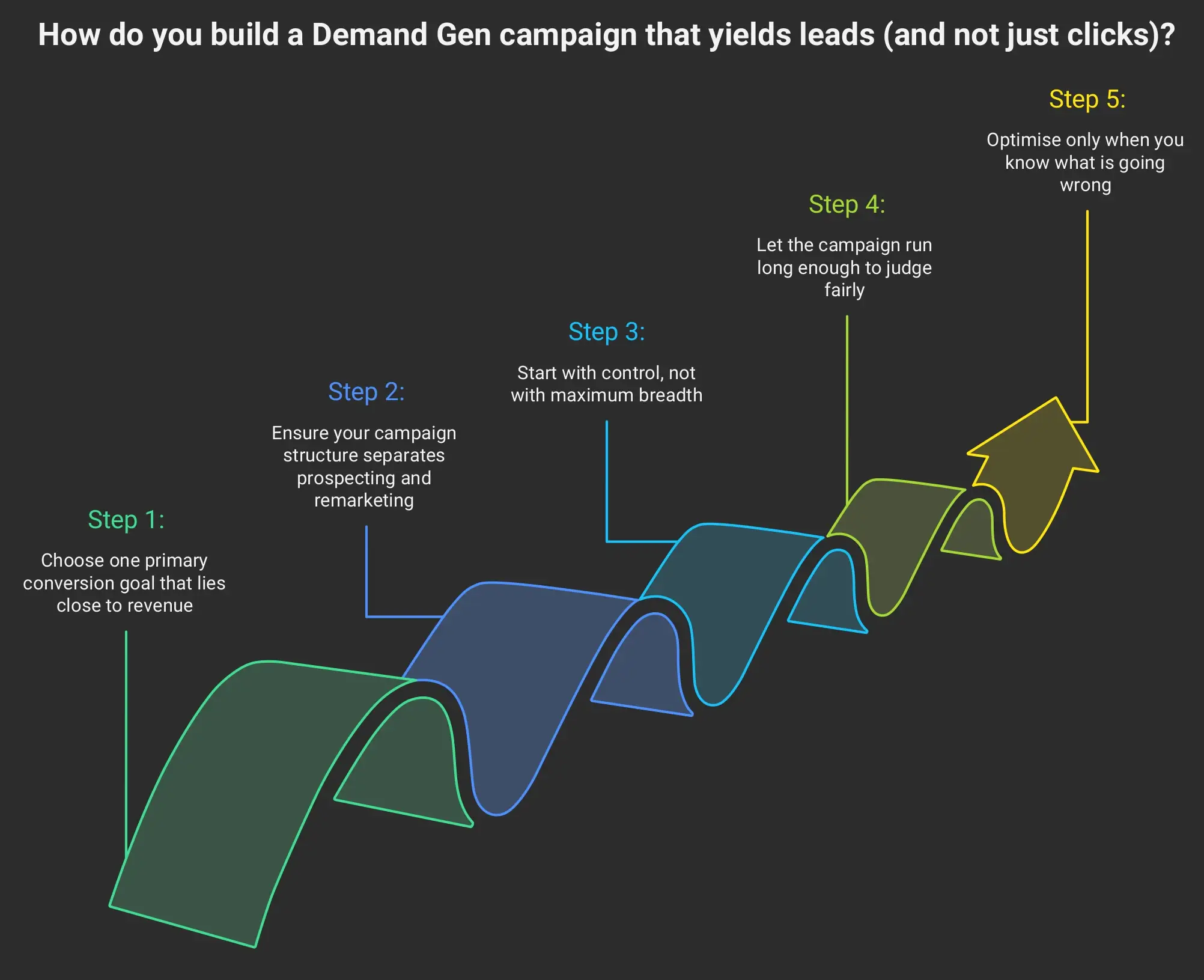
Demand Gen works in B2B only if you set up the campaign as if you are building a system, not as if you are "just turning on a campaign." Below are the steps you must take in the correct order. If you skip them, you almost always see the same pattern: high reach, many clicks, and leads that sales cannot use.

Check Icon

Step 1: Choose one primary conversion goal that lies close to revenue: Demand Gen must know what constitutes a valuable lead for you. If you deploy multiple conversions at the same time (download, contact, newsletter, scroll), Google will automatically optimise for the easiest conversion. In B2B, that is almost never the best lead. Therefore, choose one main conversion, such as a demo request, intake meeting, or quote request and make all other actions secondary.

Check Icon

Step 2: Ensure your campaign structure separates prospecting and remarketing: A common mistake is that remarketing and new target groups are mixed together. Then your results seem good, but you are mainly measuring "people you were going to get anyway." By separating cold and warm target groups, you see whether Demand Gen actually creates new demand or only harvests existing interest.

Check Icon

Step 3: Start with control, not with maximum breadth: In B2B, "opening it up wide so the algorithm can learn" is usually a recipe for noise. Demand Gen then gets too much freedom and finds the cheapest clicks, not the best leads. Therefore, start with a clear target group, clear creatives, and a clear landing page, so that you first build a reliable signal.

Check Icon

Step 4: Let the campaign run long enough to judge fairly: Demand Gen needs time to recognise patterns. If you start making adjustments after a few days based on CTR or CPL, you are optimising on superficial metrics. B2B requires patience and evaluation based on lead quality, not volume.

Check Icon

Step 5: Optimise only when you know what is going wrong: If the campaign performs poorly, the solution is not "more budget" or "different targeting" without a diagnosis. First, look at where it is going wrong: is it the target group, the creative, the landing page, or the conversion? Demand Gen is sensitive to noise, so every optimisation must have a clear reason.

If you follow these steps, you build Demand Gen in a way that not only yields leads, but primarily leads that sales can actually follow up.

How do you choose targeting that works for B2B?

With Demand Gen, targeting is not a "setting," but a selection process. You do not choose one perfect target group in advance; you build a set of segments with which you discover as quickly as possible where the sales-worthy leads are coming from. Below is a practical step-by-step plan that we use in B2B to make Demand Gen predictable.

Check Icon

Step 1: Always start with 1 target group that already has proof: Never start with only broad prospecting. Your first target group should be a segment of which you already know that it fits your ICP, such as website visitors, engaged users, or a client/lead list from your CRM. This prevents Demand Gen from immediately optimising for cheap clicks. In B2B, you primarily want to build "quality signals" in the first phase, not volume.

Check Icon

Step 2: After that, add 1 prospecting target group based on problem-intent: Only when your base is running do you add prospecting. The best prospecting segments are custom segments based on search behaviour around the problem you solve. In doing so, do not choose generic terms such as "marketing agency" or "software," but terms that show a clear pain. For example: "B2B lead generation," "CPL too high," "pipeline not growing," "marketing qualified leads vs sales qualified leads." These types of search terms select people who are in the right mental phase.

Check Icon

Step 3: Keep your targeting intentionally simple (maximum 2–3 segments at a time): Demand Gen is sensitive to noise. If you activate 6 target groups at the same time, you still won't know what works after 2 weeks because your data is fragmented. B2B conversions are scarce, so you must force the campaign to build enough volume per segment to draw conclusions.

Check Icon

Step 4: Make one hard rule: you optimise for lead quality, not for CPL: The segment with the lowest CPL is often the worst segment in B2B. Therefore, look at concrete quality signals per target group, such as: is a company name coming in, is it a business email, does the job title fit, and is the lead followed up by sales? If a segment yields many "leads" but sales says it is junk, you must stop that segment, even if it seems cheap.

Check Icon

Step 5: Only expand when you have one segment that structurally delivers good leads: The biggest mistake in Demand Gen is scaling too early. First, you must find one segment that predictably gives sales-worthy leads. Only then do you expand with a second prospecting segment or a broader variant. Demand Gen works best in B2B when you build it like a funnel: first, one proven source, then controlled expansion.

Which creatives and landing pages convert in B2B?

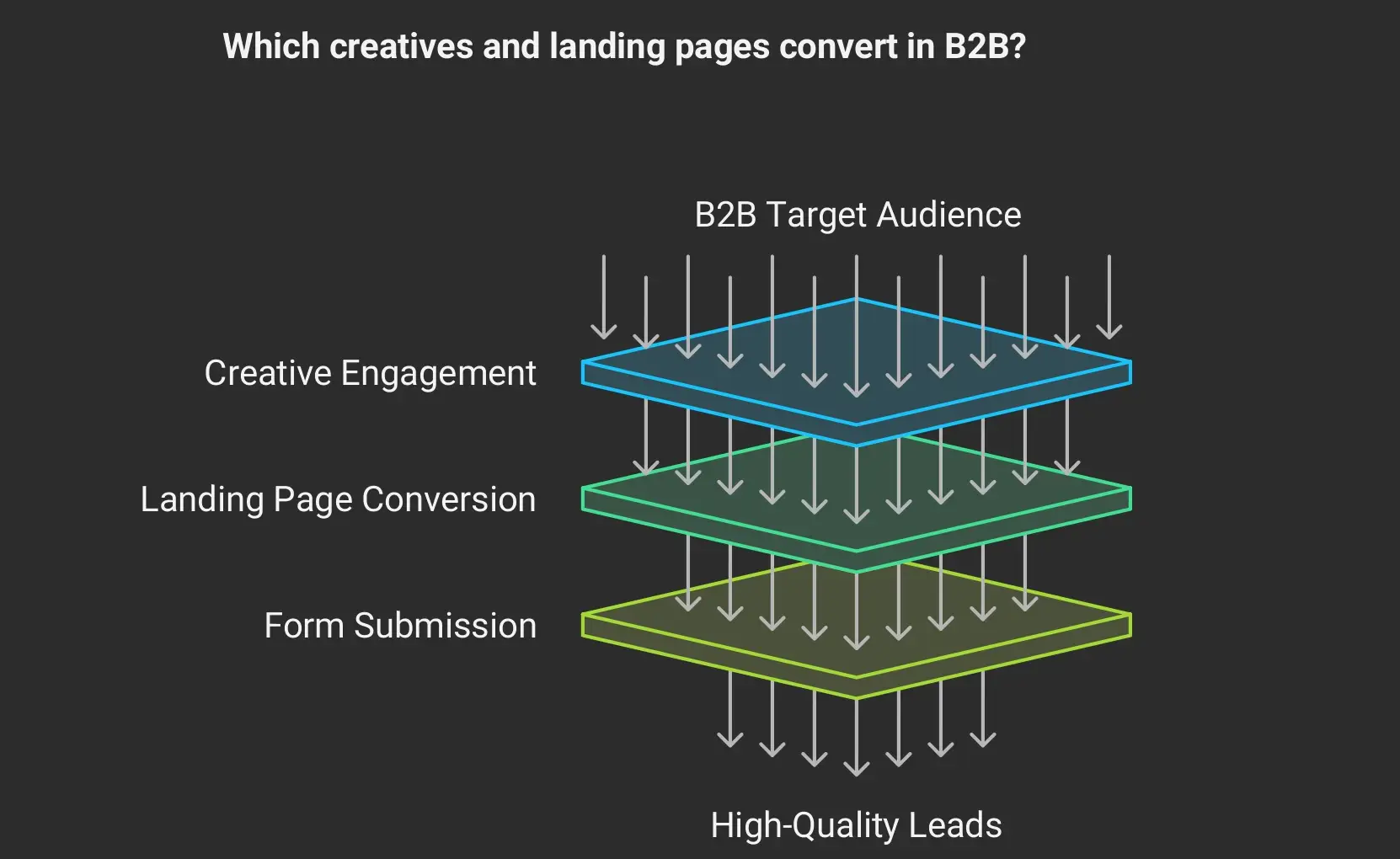
In Demand Gen, you do not win with "pretty visuals," but with creation that makes it clear in 2 seconds: we recognise this problem, and we demonstrably solve it. In B2B, Demand Gen therefore works best with creatives that grab one clear frustration or ambition, and that provide direct proof that you are a serious party.

The most converting creative angles for B2B are almost always one of these three:

Check Icon

The first is problem → consequence → solution. You name a recognisable problem and directly link a business impact to it. For example: "Many B2B leads, but sales says: junk? Then you are probably optimising for the wrong conversion." This type works well because it directly creates urgency and positions you as an expert.

Check Icon

The second is benchmark → comparison → insight. B2B target groups respond strongly to "Where do I stand compared to the market?" Think of: "Most B2B accounts still steer on CPL. As a result, lead quality is structurally declining." This works particularly well if you mention one concrete data point or pattern in your advertisement that you often see in audits.

Check Icon

The third is case → result → mechanism. So not just "+40% leads," but: "+38% SQLs in 90 days through offline conversion tracking + Demand Gen + remarketing." This works because Demand Gen is cold traffic: proof must be visible quickly.

For formats, we see in B2B that short videos and static visuals with hard copy perform better than ‘branding’ creatives. A video does not have to be high-end, but must get to the core quickly: problem, proof, next step. Carousels work particularly well if you deploy them as a mini-framework, for example, "Step 1, Step 2, Step 3" or "3 signals that Demand Gen does work."

The landing page must then have one task: to take the visitor to a logical next step in less than 30 seconds.

The best B2B Demand Gen pages are therefore not SEO pages, but conversion pages with a fixed structure: a sharp one-liner, problem recognition, 3 to 5 proof elements, a short explanation of the approach, and only then the form. Forms convert best if they do not ask too much, but enough to protect lead quality. Think of the company name and role, instead of just name + email.

How do you steer on lead quality and scale up responsibly?

Scaling up Demand Gen in B2B only works if you have a fixed way of measuring lead quality and base your optimisations on that. If you steer on CPL or the number of leads, Google will automatically find the easiest leads.

Those are almost always leads that fill in quickly but do not fit your target group. The solution is therefore not "better optimisation," but ensuring that your campaign learns from signals that lie closer to revenue.

The first step is that you define in advance what a good lead is. Not in marketing terms, but in sales terms. Think of a lead who has a relevant role, works at a company of a certain size, uses a business email, and actually has a problem that you solve. If you do not define this, you cannot fairly judge whether Demand Gen is working.

The second step is that you make that quality measurable. In practice, you do that by using a clear status in your CRM, such as MQL, SQL, opportunity, and won deal. Subsequently, you send back at least the SQL status to Google Ads as an offline conversion. In doing so, you give the algorithm a much stronger signal than "form completed." Demand Gen is a creation-driven channel that reaches people who are not yet actively searching, and that is precisely why the risk of low quality is greater if you only steer on form conversions.

Google also explicitly describes Demand Gen as a campaign form that stimulates engagement and action via visual placements on YouTube, Discover, and Gmail, which means that the first click is often not yet purchase intent but an initial interest signal. Therefore, you must feed back the quality later in the funnel.

The third step is that you plan your evaluation moments strictly. In B2B, Demand Gen needs time to learn because conversions are scarce and the decision cycle is longer. Therefore, do not evaluate daily, but weekly. Look not only at CPC and CTR, but especially at the ratio between leads and qualitative leads. A campaign with fewer leads but more SQLs is almost always better than a campaign with many cheap forms.

The fourth step is that you only scale up once your quality is stable. A simple but effective rule is: only increase the budget if you have consistently received leads in the recent period that sales actually follow up. If you scale up while your quality is still fluctuating, you are mainly scaling up noise. In B2B, that is the moment when Demand Gen "suddenly becomes bad," while the real problem is that you started scaling too early.

The final step is that you optimise based on cause, not based on feeling. If your lead quality drops, there is a high chance that one of these things has changed: your targeting has become too broad, your creation is attracting the wrong people, or your landing page is letting too many "quick fillers" through. By linking every optimisation to one clear hypothesis, you prevent your campaigns from becoming chaotic and you ultimately no longer knowing what works.

In short: Demand Gen only becomes predictable in B2B once you teach the algorithm what quality is, you measure the funnel up to and including SQL or deal, and you scale based on stable business signals instead of superficial lead volumes.

Conclusion: Is Demand Gen a growth accelerator for your B2B funnel?

Demand Gen is not a "fast lead machine," but it is one of the best Google Ads channels to make B2B growth predictable when Search alone no longer delivers enough volume. It works particularly well if you have a clear proposition, your tracking and CRM are in order, and you are prepared to steer on lead quality instead of CPL.

If you deploy Demand Gen with a tight campaign structure, strong creatives, and send back offline conversions (for example, SQLs) to Google Ads, you can let the channel learn on real business value.

In doing so, Demand Gen becomes not only an extra source of leads, but primarily a way to create demand with the right target group and make your entire funnel (Search, remarketing, and sales) more efficient. Are you unsure whether Demand Gen fits your B2B market? Then the most important question is not whether the channel "works," but whether your offer, tracking, and follow-up are mature enough to let Demand Gen optimise on quality. If that is correct, Demand Gen is often precisely the accelerator with which you break through the Search ceiling and structurally build more pipeline.

Frequently Asked Questions about Demand Gen for B2B Lead Generation

Is Demand Gen suitable for high-ticket B2B services?

Yes, but only if your campaign optimises for lead quality instead of forms. High-ticket B2B only works well if proof (cases, results, approach) is directly visible and you measure conversion to at least SQL or opportunity.

What is the difference between Demand Gen and Performance Max for B2B?

Demand Gen is primarily intended to create new demand via YouTube, Discover, and Gmail. Performance Max is broader and focuses on conversions across multiple Google networks. In B2B, Demand Gen is often more controllable for prospecting, while PMax can more quickly become a "mix" with remarketing and thereby distort your view.

Why does Demand Gen sometimes yield many leads, but few sales?

Because Google optimises for the conversion you measure. If your primary conversion is "form submitted," Demand Gen will automatically find the easiest fillers. The solution is a better conversion structure and ideally offline conversion tracking (SQL/deal).

How do you prevent Demand Gen from only converting existing visitors?

By always separating prospecting and remarketing into separate campaigns. If you do not do this, your performance seems better than it is because you are mainly bringing in leads who were already warm via Search, LinkedIn, or your website.

Which KPIs are the most misleading with Demand Gen in B2B?

CTR and CPL are often misleading. A high CTR can actually mean your creatives are too "clickbait." And a low CPL can mean your lead quality is collapsing. In B2B, you want to focus on SQL rate, opportunity rate, and ultimately, pipeline.

How long should you let Demand Gen run at a minimum before drawing conclusions?

At least several weeks, because the algorithm needs time to learn patterns and because B2B leads often convert with a delay. Optimising too early is one of the biggest causes of failed Demand Gen tests.

What is the biggest mistake with B2B Demand Gen landing pages?

That companies send traffic to a general service page. Demand Gen works best with a specific landing page that makes it clear within seconds: who it is for, what it yields, and why you are credible.

Should you use gated content (whitepaper) or offer a demo directly?

That depends on your funnel. Gated content works well for awareness and remarketing, but often yields more MQLs than SQLs. Offering an intake or demo directly works better if you can already show enough proof and trust on the page.

CTA Design images 1 CTA Design images 2

Ready to Grow with ANA Digital Media?

Let our experts turn your goals into real results.