Show interest in real estate, property portals, and housing finance





I hope you enjoy reading this article. If you need support with SEO , Google Ads , Facebook Ads, or Landing Pages, click on the link.
The real estate industry has shifted heavily toward digital advertising. Property buyers now spend a significant amount of time scrolling social media platforms, comparing options, watching walkthrough videos, and engaging with ads long before contacting a sales team.
Among all digital channels, Facebook and Instagram continue to dominate real estate advertising. However, many developers and consultants still struggle with one key decision: which platform actually delivers better leads and ROI?
To answer this, a performance-focused ad campaign was executed and analysed to understand how Facebook and Instagram compare when it comes to generating genuine property enquiries.
The campaign objective was clear: generate qualified leads for a residential project using paid social media ads. A lead form–based strategy was selected to reduce friction and improve conversion rates.
The ads promoted a limited-time site visit offer for a premium residential project priced at ₹1.75 crore, targeting users actively interested in home buying and property investment.
The same creatives, ad copy, targeting parameters, and lead forms were used across both platforms to ensure accurate comparison.
The campaign targeted users who:

Show interest in real estate, property portals, and housing finance
Fall within the typical homebuyer age group
Have engaged with property-related content previously
This ensured that the ads reached users with real intent rather than cold audiences.
Instead of vanity metrics, the campaign focused on performance indicators that matter in real estate marketing:
Cost per thousand impressions (CPM)
Cost per click (CPC)
Click-through rate (CTR)
Cost per lead (CPL)
Instagram delivered broader visibility at a lower cost per thousand impressions. This made it effective for generating awareness and introducing the project to new audiences. Visual creatives showcasing layouts, amenities, and lifestyle elements performed particularly well.
Facebook, while slightly more expensive in reach, showed stronger intent-based behaviour from users.
Facebook recorded a marginally lower cost per click. Users were more likely to click directly on the ad and submit their details. Instagram users, on the other hand, showed higher engagement through saves and profile visits, indicating strong interest but slightly delayed action.
This suggests that Instagram works well for warming up audiences, while Facebook pushes faster conversions.
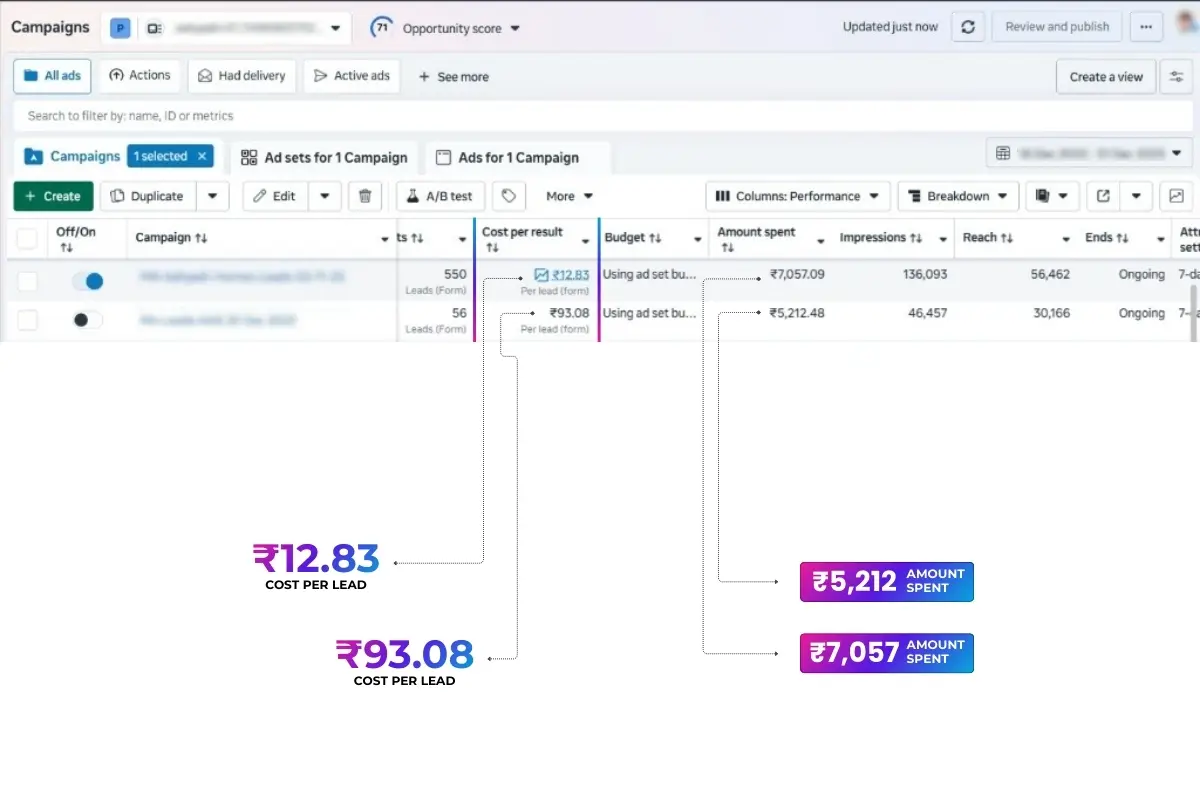
The most important metric—cost per lead—showed competitive performance across both platforms.
Facebook delivered slightly lower average lead costs, while Instagram leads showed higher engagement during follow-ups. When retargeting was applied, Instagram’s cost efficiency improved further.
This pattern highlights the importance of a combined platform strategy rather than relying on a single channel.
A major insight from the campaign was mobile performance. Most leads were generated through mobile placements, and when only mobile traffic was considered, Instagram’s performance came very close to Facebook.
Given that most property research happens on mobile devices, this reinforces Instagram’s role as a serious lead-generation platform, not just a branding tool.
The strongest results came from a two-step approach:
1. Use Instagram to build awareness and engagement
2. Retarget interested users on Facebook to capture leads
This approach reduced overall lead cost and improved enquiry quality. Users who first engaged with visuals were more likely to convert when retargeted later.
This exact strategy was implemented for a Thane-based residential project, helping filter casual browsers and attract serious buyers.

Facebook delivers slightly faster conversions.
Instagram drives stronger engagement and recall.
Best results come from using both platforms together.
For high-ticket properties, especially premium residential projects, platform synergy matters more than platform preference. To see how we can apply these insights to your specific project, check out our Meta Ads services.
This case study shows that Instagram has evolved into a performance-driven platform, while Facebook continues to remain strong for direct lead generation. When used together with the right funnel strategy, both platforms can deliver consistent, cost-effective results for real estate campaigns.
Advertisers who track performance, optimise creatives, and balance awareness with retargeting consistently outperform those using a single-channel approach.


Let our experts turn your goals into real results.
ⓒ Copyright 2026 . All Rights Reserved By ANA Digital Media