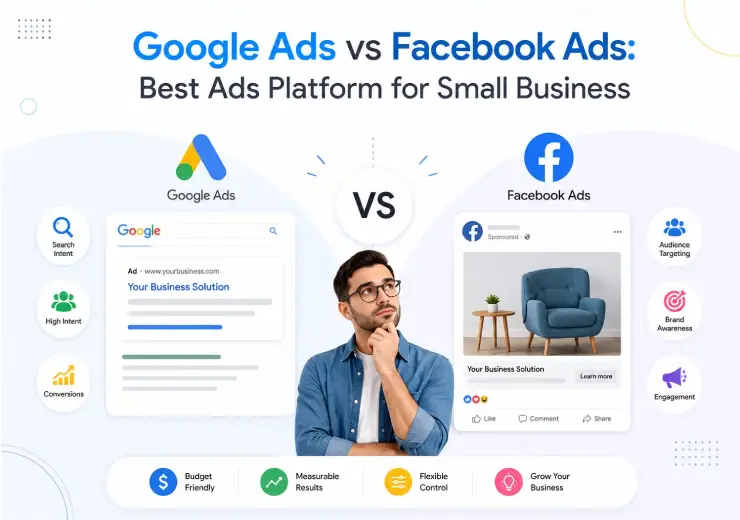
Google Ads shows your ad to people who are already searching for what you sell. This means higher buying intent, but also a higher cost per click.


I hope you enjoy reading this article. If you need support with SEO , Google Ads , Facebook Ads, or Landing Pages, click on the link.
If you run a small business, you have probably asked yourself this question: should I put my money into Google Ads or Meta Ads? Both platforms promise leads, sales, and growth. Both have millions of small business advertisers already using them. But they work in very different ways, and picking the wrong one — or using the right one the wrong way — can waste your budget fast.
In this guide, we compare Google Ads and Facebook Ads (Meta Ads) in plain, simple language. No jargon, no confusion — just facts, real numbers, and practical guidance you can actually use to make a smart decision for your business in 2026.

Google Ads shows your ad to people who are already searching for what you sell. This means higher buying intent, but also a higher cost per click.
Meta Ads (Facebook and Instagram) shows your ad to people based on their interests and behaviour, even before they start looking for you. This is cheaper per click but needs stronger creative to convert.
The average Google Ads cost per click in 2026 is roughly $2.50 to $5 globally (₹15 to ₹150 in India), while the average Meta Ads cost per click is roughly $0.70 to $1.20 globally (₹2 to ₹35 in India) — but this changes a lot by industry.
There is no single "better" platform. The right choice depends on your product, your budget, your sales cycle, and how ready your customer is to buy when they see your ad.
Most successful small businesses eventually use both platforms together, but for different jobs.
When small business owners search for the best ads platform, they usually mean one thing — which one gives more leads for less money. The honest answer is: it depends on what you sell and who your customer is.
Google Ads is built around intent. Someone types "plumber near me" or "buy running shoes online," and your ad appears right there, at the exact moment they are looking. Meta Ads is built around discovery. Someone is scrolling Instagram or Facebook, not looking for you at all, and your ad interrupts their feed with something interesting enough to make them stop and click.
This one difference explains almost everything else in this guide — the cost, the ad format, the conversion rate, and even the type of business each platform suits best. Google Ads customers are usually closer to the end of their buying journey. Meta Ads customers are usually earlier in that journey, sometimes not even aware they have a problem your product solves.
For most small businesses, the real answer is not "Google Ads or Meta Ads" — it's "Google Ads and Meta Ads, used for different jobs." Google Ads captures people who are already looking for a solution. Meta Ads creates interest in people who weren't looking yet, and then follows up with them through retargeting. But if you only have budget for one platform right now, the sections below will help you decide which one fits your business first.

Google Ads (formerly known as Google AdWords) is Google's advertising platform. It lets businesses show ads on Google Search, YouTube, Gmail, Google Maps, and millions of partner websites through the Google Display Network. You choose keywords related to your business, set a bid, and Google runs an instant auction every time someone searches that keyword. If you win the auction, your ad appears. Because the person is already searching for something specific, Google Ads captures buyers close to the point of decision — which is why it's often called "intent-based advertising." A well-run Google Ads campaign can put a small local business right at the top of search results, ahead of much bigger competitors, as long as the ad is relevant and well targeted.
Meta Ads is the advertising system that runs across Facebook, Instagram, Messenger, and Threads. Instead of keywords, Meta uses your audience's age, location, interests, past behaviour, and lookalike data (people who behave like your existing customers) to decide who sees your ad. This makes Meta Ads a strong platform for brand awareness, visual products, and reaching people who don't yet know they need your product — often called "interest-based advertising." Meta's algorithm has also become far more automated in 2026, with tools like Advantage+ campaigns handling much of the audience targeting and creative testing for you, which makes it more beginner-friendly than it used to be.
| Feature | Google Ads | Meta Ads (Facebook/Instagram) |
|---|---|---|
| Ad Placement | Search Results, YouTube, Gmail, Display Network | Facebook Feed, Instagram Feed, Reels, Stories, Messenger |
| Targeting Method | Keywords & Search Intent | Interests, Demographics, Behaviors, Lookalike Audiences |
| Best For | High-intent buyers, Local Services, B2B | Visual Products, Brand Awareness, Impulse Purchases |
| Average CPC (Global) | $2.50–$5.00 (Search) | $0.70–$1.20 |
| Average CPC (India) | ₹15–₹150 (Finance & Legal can exceed ₹500) | ₹2–₹35 |
| Average CPM (Global) | $2–$12 | $7–$14 |
| Ad Format | Search, Display, Shopping, Video | Image, Video, Carousel, Reels, Stories |
| Buyer Stage | Bottom of Funnel (Ready to Buy) | Top & Middle of Funnel (Awareness & Consideration) |
| Learning Curve | Moderate to Steep | Beginner-Friendly with Automation |
| Best Campaign Goal | Leads, Sales, Phone Calls | Brand Awareness, Engagement, Retargeting |
| Minimum Realistic Monthly Budget | $300–$500 (₹15,000–₹30,000 in India) | $200–$400 (₹10,000–₹30,000 in India) |
Cost is where most small business owners get confused, because every website quotes a different number. Here is an honest, realistic range based on 2026 industry benchmark data, both globally and in India.
Average CPC (Search): roughly $2.50 to $5, though it can go past $6–$7 in competitive fields like legal and insurance, and as low as $1.16 in e-commerce.
Average CPM: roughly $2 to $12, depending on the network and format.
Average conversion rate: around 3.75% to 5% on Search campaigns.
Average cost per lead (CPA): roughly $50 to $80 across most industries.
Average CPC: roughly $0.70 to $1.20 for traffic campaigns, rising to around $1.90 to $2.10 for lead generation campaigns.
Average CPM: roughly $11 to $14, and it has been rising year over year as more advertisers join the platform.
Average conversion rate: around 8% on lead ads.
Average cost per lead: roughly $27 to $38.
Average CPC: roughly ₹15 to ₹150, with local services and e-commerce on the lower end (₹5–₹40) and finance, legal, and real estate much higher (₹100–₹500+).
A typical small business budget of ₹15,000 to ₹30,000 per month is a realistic starting point for testing the platform.
Average CPC: roughly ₹2 to ₹35 depending on industry and creative quality.
Average CPM: roughly ₹50 to ₹400.
Average cost per lead: roughly ₹50 to ₹500 for service businesses.
The simple takeaway: Google Ads usually costs more per click, but the person clicking is closer to buying. Meta Ads usually costs less per click, but you need a stronger offer or creative to turn that click into a sale. In both markets, cost per lead or cost per sale matters far more than cost per click alone — a cheap click that never converts is more expensive than an expensive click that does.

Captures buyers with strong purchase intent — they are already looking for what you sell
Great for local businesses ("near me" searches, "book now," "call now")
Works well for B2B and service-based businesses with longer sales cycles
Detailed keyword-level control and reporting, so you know exactly which search terms bring customers
Pay-per-click model means you only pay when someone actually clicks
Higher cost per click in competitive industries, especially legal, finance, and insurance - Steeper learning curve for beginners — keyword match types, negative keywords, and Quality Score all affect cost
Limited creative and visual storytelling on Search ads compared to social platforms
Can be easy to overspend without close monitoring, especially on broad match keywords
Lower cost per click on average, making it more accessible for small budgets
Strong for visual products and brand storytelling through images, video, and Reels
Powerful retargeting and lookalike audience tools to reach people similar to your best customers
Easier to start with a small budget, and automated tools like Advantage+ reduce the manual setup work
Lower buyer intent — people are scrolling for entertainment, not actively searching to buy
Ad fatigue happens faster, so creative needs regular refreshing (most guides recommend refreshing every 7–14 days)
iOS privacy changes have made tracking and attribution harder, so reported results can look better than actual results
Rising CPMs in 2026 mean costs are increasing as more advertisers compete for the same audience
Local service businesses (plumbers, salons, clinics, repair shops): Google Ads usually wins, since customers actively search for these services when they need them urgently. A "near me" search converts a stranger into a customer within minutes.
E-commerce and fashion brands: Meta Ads usually wins, thanks to strong visual formats and impulse-buy behaviour on Instagram and Facebook Reels.
B2B and high-ticket services: Google Ads usually wins for capturing intent, while Meta Ads works well for retargeting people who visited your site but didn't convert the first time.
New or unknown brands: Meta Ads usually wins for awareness first, since people are not yet searching Google for a business they don't know exists.
Restaurants, cafes, and lifestyle brands: Meta Ads usually wins, since food and lifestyle content performs well in visual, scroll-friendly feeds.
Real estate and finance: Both platforms are expensive here due to high customer value, but Google Ads tends to bring more qualified, ready-to-act leads, while Meta Ads is better for early-stage nurturing.
Education and coaching businesses: A mix works best — Google Ads for people actively searching for a course or program, Meta Ads for building trust through video content before they are ready to enrol.
Google Ads wins when a customer already knows what they want and is ready to act. If your business depends on urgent, high-intent searches — like "emergency locksmith," "book flight tickets," or "buy laptop online" — Google Ads puts you directly in front of that ready-to-buy moment. It also wins for businesses with a longer sales cycle where being found at the right search moment matters more than being discovered casually while scrolling.
Google Ads also wins when your product or service solves a clear, definable problem that people already know they have. Nobody scrolls Instagram thinking "I need a plumber," but plenty of people search Google for exactly that the moment a pipe bursts. In these situations, showing up first in search results is often the single biggest driver of new business.
Meta Ads wins when your product needs to be seen to be wanted. If you sell something visual — clothing, jewellery, home decor, food, or fitness products — a scroll-stopping image or video can create demand that didn't exist before the person saw your ad. Meta Ads also wins for small budgets, since you can start testing with a small daily spend and scale up only what performs, without needing deep keyword research first.
Meta Ads also wins when you want to build a relationship with your audience over time, not just capture a single transaction. Retargeting ads — showing your ad again to people who visited your website or added something to their cart but didn't buy — consistently perform better than cold audience ads, and this is one of Meta's biggest strengths.
Before you spend a single rupee or dollar, it helps to work backwards from your goal instead of just picking a number that feels comfortable.
1. Decide your monthly revenue goal from ads. For example, ₹1,00,000 in new sales, or 20 new client enquiries.
2. Estimate your average conversion rate. Google Search ads convert around 3–5% of clicks on average; Meta lead ads convert around 7–8%.
3. Estimate your close rate — how many leads actually become paying customers (often 20–40% for service businesses).
4. Reverse-calculate the ad spend needed. If you need 20 leads, your close rate is 25%, and cost per lead is ₹300, you need roughly ₹6,000 just for lead generation, plus a buffer for testing and optimisation.
5. Add 20–30% extra budget for the first month while the platform's algorithm learns what works, since early campaigns are rarely as efficient as they become after a few weeks of data.
As a rough starting point for small businesses in 2026: budget at least $300–$500 per month (₹15,000–₹30,000 in India) for Google Ads, and at least $200–$400 per month (₹10,000–₹30,000 in India) for Meta Ads. Anything lower rarely gives the platform's algorithm enough data to optimise properly.
- Judging results too early. Both platforms need a learning period — usually 1 to 2 weeks — before performance stabilises. Stopping a campaign after three days of "no results" wastes the data you already paid for.
- Focusing on cost per click instead of cost per lead or sale. A ₹10 click that never converts is worse than a ₹50 click that turns into a customer.
- Using the same ad creative for too long on Meta Ads. Audiences get tired of seeing the same image or video, and performance drops. Refreshing creative every 1–2 weeks keeps costs down.
- Sending traffic to a weak landing page. Even the best ad cannot fix a slow, confusing, or untrustworthy website. Landing page quality directly affects both your cost per click (on Google, through Quality Score) and your conversion rate.
- Not tracking conversions properly. Without conversion tracking set up correctly, you cannot tell which keywords or audiences are actually bringing you customers, and you end up guessing instead of optimising.
- Copying competitor budgets without matching their business model. A ₹50,000/month budget might be normal for a real estate business but wasteful for a small local bakery. Budget should match your average order value and margins, not what a bigger business spends.
There is no universal winner in the Google Ads vs Meta Ads debate. Google Ads is better when you want to catch people who are already searching and ready to buy. Meta Ads is better when you want to build awareness, retarget website visitors, and sell visual products at a lower cost per click.
For most small businesses in 2026, the smartest approach is not choosing one over the other — it's using Google Ads to capture demand and Meta Ads to create demand. If your budget only allows one platform right now, match your choice to your business type using the comparisons above: urgent, high-intent local services usually do better on Google Ads, while visual, discovery-driven products usually do better on Meta Ads.
Whichever platform you start with, remember that the platform is only half the equation. A clear offer, a fast landing page, and consistent testing matter just as much as which button you click to launch the campaign.


Let our experts turn your goals into real results.
ⓒ Copyright 2026 . All Rights Reserved By ANA Digital Media