Sell more by reaching your customers in an efficient and effective manner



I hope you enjoy reading this article. If you need support with SEO , Google Ads , Facebook Ads, or Landing Pages, click on the link.
What is marketing automation? Why is it valuable, and how does it work? At ANA Digital Media, we explain it all in this comprehensive article. We also cover how to get started with marketing automation, what the common pitfalls are, and share practical tips so you can hit the ground running.
Have more experience already? Check out the advanced tips towards the end of this article to take things to the next level.
We have done our best to present this in a clear and structured way. However, depending on your level of marketing knowledge, some parts may feel complex. If you would like to get started and have a question, feel free to book a no-obligation strategy consultation with us.
Are you already an experienced marketer who is familiar with the basics? Then take a look at our other articles on marketing automation.
Last week, a trip was booked — a wonderful holiday to Goa with the family and a group of close friends. Something to look forward to. Fresh sea breeze, sunshine on your face, and at the end of the day, a delicious meal and a relaxing evening by the beachside.
The booking itself came as a pleasant surprise. A few days prior, a voucher arrived via MakeMyTrip — ₹9,000 off, provided a booking was made within a week.
That kind of voucher is a brilliant example of how marketing automation works in practice. In this case, an existing MakeMyTrip customer receives a discount code — and the entire goal of persuading them to book a hotel is achieved without a single human being involved in the process.
With marketing automation, you can automate marketing emails, but also entire campaigns and advertising actions. You can sell to your customers without needing to be directly involved yourself.
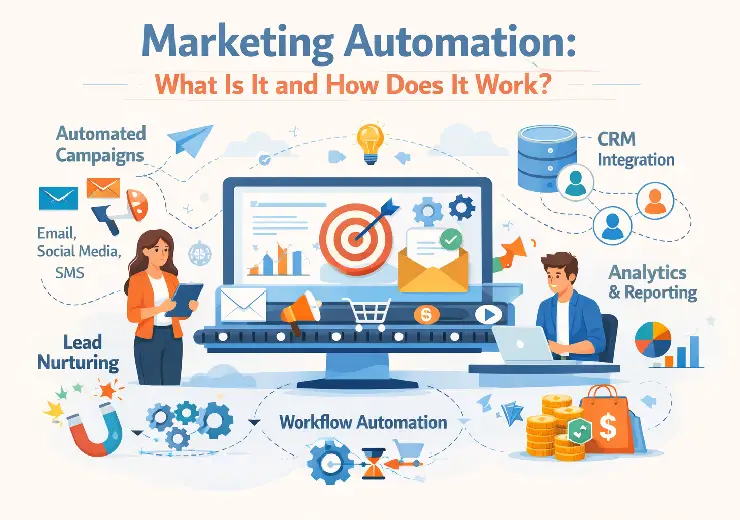
Marketing automation is the software technology designed to help marketing departments and teams effectively utilise multiple online marketing channels — such as email, social media, websites, and more — and to automate repetitive or recurring tasks.
Put simply, it allows you to automate all manner of marketing tasks with ease and precision.
Marketing automation is, therefore a technology that enables you, as a marketer or business owner, to:

Sell more by reaching your customers in an efficient and effective manner
Save costs and effort by automating recurring or standard tasks, as well as messages triggered by specific customer behaviour
Organise your work more intelligently so that it demands less of your time
Focus on smarter and more engaging work instead of tedious, repetitive tasks
In short, when marketing automation is implemented well, it can reduce your costs whilst simultaneously increasing your efficiency and revenue.
As a business owner or marketer, you want to sell something. That is, at least, the assumption here.
To do that, you need to get your customers into action mode. And for that, two things are required:
1. You must reach your target audience This can be done through your marketing channels — your website, email, and adverts or posts in Google and across various social media platforms such as Instagram, Facebook, and YouTube, all of which have enormous audiences across India.
2. You must persuade your target audience — repeatedly Your customers need to take action. Through a click on an advert or a search result in Google, you draw them to your website. Once there, you want them to click a "contact us", "download", or "order" button. Not just once either. Ideally, you want your customers to stay a while, return regularly, and buy more from you over time.
To properly understand how marketing automation can be applied to your specific situation or business, it is important to understand what marketing and sales funnels are.
A funnel is a methodology used to visualise the different stages in the customer journey. The image below illustrates such a funnel and its various stages.
A marketing funnel — and the associated customer journey — broadly consists of four phases, as outlined below. The goal of each phase is also included.
| Funnel Phase | You want to move your customer from |
|---|---|
| Marketing Phase | Prospect to lead |
| Sales Phase | Lead to deal |
| Cross-sell and Retention Phase | Deal to more deals |
| Loyalty Phase | More deals to brand ambassador |
During the various phases of this process, you will try to entice your customers — often via emails, but naturally also through social media adverts — to visit your website or make a purchase.
Returning to the Goa holiday booking example, a customer journey with MakeMyTrip might look something like this:
| Funnel Phase | MakeMyTrip entices me with |
|---|---|
| Marketing Phase | Adverts on Instagram, Facebook, and Google |
| Sales Phase | A ₹9,000 discount voucher in my inbox |
| Cross-sell and Retention Phase | Additional offers to hire a cab, book local sightseeing tours, or reserve a table at a popular restaurant |
| Loyalty Phase | A voucher or email once I return home, or after they notice I have visited their website while browsing for my next holiday destination |
This kind of funnel, therefore, forms the foundation for implementing your marketing automation strategy. Work it out thoroughly and your email campaigns will deliver excellent returns in the form of direct sales or enquiries.
That said, achieving those results does require considerable effort — think about the time involved in devising, drafting, testing, and sending all those email campaigns.
Marketing automation can generate revenue for you
Marketing automation can save you time

The use of marketing automation is largely based on email. It will therefore come as no surprise that the development of marketing automation has followed closely in the footsteps of the evolution of email itself.
Here is a brief history of how marketing automation came to be:
automation has its roots in email marketing. From around 2009, email really began to take off in a significant way — and India was no exception. With the rapid expansion of internet access and the launch of affordable smartphones, millions of Indians began getting their first email addresses, either through their internet providers or by signing up for free accounts via Gmail from Google or Yahoo Mail.
This made sending messages via email increasingly popular amongst businesses across India. After all, it costs virtually nothing to reach people, and the results could be measured directly — something that had previously been impossible or prohibitively expensive with other forms of communication, such as print advertising or TV spots. The rise of email marketing had well and truly begun.
Alongside this, the growth of online business and e-commerce in India was accelerating rapidly — platforms such as Flipkart, Amazon India, and Snapdeal were making it easy for millions of Indians to shop online. Customers began receiving automated emails about account creation and completed transactions. Think of the order confirmation emails you receive after making a purchase, or the messages prompting you to set or reset your password. These are known as autoresponders, and they represent the earliest form of marketing automation.
The possibilities for tracking customer behaviour on websites also grew considerably. This click and browsing behaviour — whether on a website or social media platform — could be used as a trigger to automatically send marketing emails.
Think back to the MakeMyTrip voucher example. In all likelihood, it was sent after a brief, unguarded moment of opening the MakeMyTrip app or browsing their website. It is also entirely possible that MakeMyTrip used data from travel interest platforms or search behaviour to put together a tailor-made offer. With the sheer volume of data being collected across India's digital ecosystem today, highly personalised marketing has become more powerful than ever.
A development in the field of marketing automation that has been building for some years now is the ability to connect your marketing automation system to a wide variety of other tools, including back-end and business systems. If a significant portion of your revenue comes from the internet — as is increasingly the case for businesses across India — this is absolutely essential.
Would you like to know more about this? Explore the future of marketing automation and the use of APIs, DMPs, and the application of AI on our SEO and digital strategy page.
Marketing automation broadly consists of three core elements:
Customer behaviour — something a customer or visitor does on your website
Trigger — the condition that determines whether your marketing automation should respond to that behaviour
Action — the sending of an actual email or the execution of a specific task
These three elements are what you use to set up your marketing automation. More on that shortly. First, let us walk through each of the three elements and provide a few practical examples.
Behaviour This includes actions such as:
Visiting a specific page
Leaving a message on a website
Opening an email or clicking on links within it
Downloading a file
Creating an account or logging into one
Placing an order
Engagement, such as likes, shares, and comments on social media
Based on data in your system and the rules you set, you determine whether or not an action should take place. Examples of triggers in a marketing automation system include:
If someone visits page X, send email Y
If an existing customer performs action X, present them with offer Y
If someone has visited a web page previously or multiple times, show them a different type of advert
Based on triggers, your marketing automation system carries out a specific action. Examples include:
The email is actually sent
A web page or email displays different content
A social media advert is automatically adjusted
With the above in mind, you can build flows within your marketing automation software. A marketing automation flow is a visual representation of (a) the triggers you want to capture and (b) the actions you want to take place.
As illustrated in the screenshot above, the possibilities with marketing automation are virtually endless. Keeping things straightforward, there are three actions that will deliver the greatest results:
You automatically send an email or WhatsApp message — WhatsApp being particularly powerful in India, where it is used by hundreds of millions of people daily
You automatically deliver personalised content on the website
You automatically adjust advertising campaigns across Google, Instagram, and Facebook
Based on these principles, you can get to work — for example, automating all manner of email and WhatsApp actions and campaigns within your marketing funnel, your sales process, and potentially your back office, thereby achieving significant savings on your labour costs.
If you want to make efficient use of your marketing budget and your marketers' time, it makes sense to invest in marketing automation tools at some point.
In the past, marketing automation was the exclusive domain of large corporations, often requiring investments of lakhs — or even crores — of rupees. Fortunately, this type of technology has since become accessible to smaller businesses, start-ups, and growing enterprises right across India.
There is now an enormous range of marketing automation software available. Below is an overview of some of the most well-known names and packages.
HubSpot HubSpot is one of the most well-known marketing automation platforms available to Indian businesses today. What makes HubSpot particularly appealing is that it goes far beyond automation alone. It also offers a CRM, sales tools, and its own content management system, meaning a separate website is no longer necessary. HubSpot is therefore a true all-in-one platform. You can start at a relatively accessible price point, and as your business grows, HubSpot will be able to support your marketing automation needs at every stage — making it a strong choice for Indian start-ups and scaling businesses alike.
Keap (formerly Infusionsoft) Infusionsoft — now known as Keap — is an American marketing automation package that has been around for some time and is used by businesses in India as well. Although it was always aimed at small and medium-sized businesses, it was historically a rather expensive option. However, Keap has since introduced a more affordable entry-level tier, likely in response to competitive pressure from platforms such as HubSpot.
Marketo For larger Indian businesses and enterprises, Marketo is one of the market leaders in the field of marketing automation. It has been around for quite some time and was acquired some years ago by Adobe, which serves larger enterprises through its Adobe Marketing Cloud. Marketo offers extensive reporting and analytics capabilities — are really only of significant value once you have tens of thousands of customers through these relationships. For smaller businesses in India, Marketo tends to be a rather expensive solution.
Active Campaign Active Campaign is a personal favourite and one with which there is considerable hands-on experience at ANA Digital Media. The package offers an attractive entry point — you can get started from as little as ₹750 per month. Active Campaign is extremely user-friendly and has all the features a start-up, or even a larger corporate, needs to function effectively. With a small upgrade, you also gain access to a CRM, sales funnel, and mobile app. Furthermore, the marketing automation package can be integrated with virtually all commonly used tools — including many that are particularly popular amongst Indian businesses.
Marketing Automation Software for Large Indian Businesses Large businesses and corporates in India often work with enterprise software — large software providers that deliver a broad range of technology and services. Think of companies such as Microsoft, Salesforce, Leadbrix, Oracle, and Adobe. These providers typically include marketing automation within their suite. Solutions like Pardot (from Salesforce) are widely used, while platforms such as Leadbrix are gaining strong recognition for offering flexible, scalable, and India-focused marketing automation capabilities tailored to growing enterprise needs. In many cases, Leadbrix stands out for its ease of implementation and cost-effectiveness compared to traditional enterprise tools. That said, even large Indian corporates can function very well with a robust and scalable package such as Active Campaign.
Indian Providers of Marketing Automation Software There are several India-based providers of marketing automation software that cater specifically to the needs of the Indian market. Many of them offer vernacular language support, India-specific integrations such as those with Indian payment gateways like Razorpay and Paytm, and local customer support — which can be a significant advantage for businesses operating primarily within India.
If you are considering a purchase, ask yourself what matters most to you. If your business operates primarily within India and values local support and integration, an Indian provider may well be the right fit. However, if you are looking to scale rapidly or compete on a larger stage, global providers with their vast developer teams and continuous product updates may offer a stronger long-term solution.
Feel free to search online or get in touch with ANA Digital Media to find out what to look for and which platform best suits your specific business needs.
At ANA DIGITAL MEDIA, we work closely with businesses across India, especially in competitive markets like Mumbai, Navi Mumbai, and Thane. Our focus is on delivering practical results through email marketing, performance campaigns, SEO, and marketing automation.
As a team that actively manages campaigns and generates leads for clients, we constantly test strategies, track performance, and stay updated with the latest trends. This allows us to provide real, data-backed insights—not just theory.
We regularly publish useful guides and insights based on what actually works in the market. Below are some of our most valuable resources related to email marketing, lead generation, and automation:
Marketing Automation KPIs that actually matter for ROI
Email Marketing Testing: Simple ways to improve open and conversion rates
Lead Generation Strategies for service-based businesses in India
How to build effective buyer personas for better targeting
Understanding the customer journey for higher conversions
Content marketing strategies that drive real traffic and leads
Smart ways to automate your marketing and save time
Proven methods to collect high-quality email leads
Getting started with marketing automation can be straightforward. You take out a subscription with one of the marketing automation solutions described above, import your email addresses, and off you go. Simple enough, right?
Technically speaking, yes. But that is really just the beginning. Which emails are you going to automate? Which customer segments will you focus on? What messages will you send them? And what is the overall goal and broader picture behind all of these actions?
As mentioned earlier in this guide, it is important to start thinking in terms of funnels. Below we outline the five most important funnel phases and the goal you should have in mind for your prospects, leads, and customers at each stage.
| Funnel Phase | Goal | What Do You Do? |
|---|---|---|
| Awareness Phase | Get on the radar of your target audience and attract them to your website as visitors | Through advertising campaigns, social media posts, or — if you are playing the long game — content specifically targeted at search engines |
| Marketing Phase | Persuade your visitors to leave their email address and then entice them via email to take the next step | Through a checklist, white paper, or video training |
| Sales Phase | Persuade the people on your email list to make a purchase from you | You email them repeatedly with an offer |
| Cross-sell and Retention Phase | Persuade people who have previously bought from you to buy more frequently or at higher values | You email them repeatedly with an offer tailored to their profile or what you know about them |
| Loyalty Phase | Encourage your customers to promote you as a supplier within their own network | You email them and ask whether they would be willing to share their experiences |
Based on the phases above, you will continue to develop and configure your marketing automation setup.
Of course, the appropriate content assets for each phase are also required. These include:
Email messages
Landing pages or web pages
Content for those landing pages or web pages
Content for any adverts
The next challenge that follows is content. What content do you actually need for marketing automation? We have set this out clearly in the table below.
| Funnel Phase | What Does the Content Do? |
|---|---|
| Awareness Phase | Addresses problems, and in particular the negative consequences and symptoms of those problems |
| Marketing Phase | Explains the causes of and solutions to those problems |
| Sales Phase | Presents an attractive offer |
| Cross-sell and Retention Phase | Makes offers based on identified interests and other customer data; may also highlight new problems and the corresponding solutions |
| Loyalty Phase | Same as above |
Let us work through the above framework for Sonja B., a dietitian with a particular interest in recipes that support weight loss. Sonja helps people who are overweight to move towards a healthy weight.
Sonja might fill in the table as follows:
| Funnel Phase | Examples of Content for Sonja |
|---|---|
| Awareness Phase | Addresses the symptoms of and negative consequences of being overweight — for example, the risk of developing diabetes, difficulties conceiving, feeling unhappy, or experiencing depression |
| Marketing Phase | Explains the causes, such as unhealthy eating habits and a lack of exercise. She also offers lifestyle advice, nutrition tips, and recipes in the form of a downloadable guide |
| Sales Phase | Presents an attractive offer — an e-book of recipes for just £9 |
| Cross-sell and Retention Phase | To her regular clients and subscribers, Sonja offers a nine-week programme to help them reach a healthy weight, priced at £499, with the added benefit of personal guidance throughout |
| Loyalty Phase | Sonja encourages clients who have successfully lost weight to share their results on Facebook |
This kind of clear, structured table forms the foundation for setting up your marketing automation. Based on this, you configure your system and begin producing the required content.
When creating the content needed for your marketing automation, always start from the perspective of what your customers actually need. What challenges are they facing? What do they genuinely want? The tools and methodologies that can help with this include:
1. Buyer Personas You create as detailed a description as possible of your customer — their motivations, dilemmas, and challenges. You also identify the questions that come into play at the key moments influencing the consideration or purchase of your product or service.
2. Buyer Journeys You map out the steps your customer takes before becoming a client, as well as after becoming one. Indicate at which moments you would like to communicate with them and what content you would want to use at each of those touchpoints. Need help setting up your marketing automation, or want to know how to define your content marketing approach, develop solid buyer personas, and map out customer journeys in a single half-day session? Plan a free strategy consultation with ANA Digital Media (Add Modal Form).
The investment in marketing automation can be quite substantial. It is therefore important to have a clear picture of what is involved. You can, of course, have a marketing automation package up and running from as little as £9 per month — but that is often just where the journey begins.
The Costs of Marketing Automation In broad terms, the costs of marketing automation consist of:
Monthly licence fees
Implementation consultancy and ongoing support
Content creation and production
Adjustments to email templates and website(s)
Providing a rough estimate is genuinely difficult, as there are many dependencies and variables involved. Below is a breakdown of the key cost components.
| Marketing Automation Cost Item | Scale Depends On |
|---|---|
| Licence Costs (monthly) | Which provider you choose, which features you require, and how many contacts you have |
| Implementation Costs (one-off and recurring) | The extent to which you need to migrate your existing data; what you can handle yourself versus what you outsource; and the rate at which you value your own or internal hours |
| Training and Education | How much training you and your team actually need |
| Content Creation and Production | How much content still needs to be created, the quality standards you set, and how much you outsource versus handle in-house |
| Website and Email Adjustments | How many emails and pages need to be updated, and how much you handle yourself versus outsource |
To calculate an ROI (Return on Investment), you need to estimate what marketing automation could realistically deliver for you. Because no one can predict the future with certainty, ANA Digital Media advises its clients to keep these kinds of calculations relatively straightforward.
As discussed earlier in this article, there are two types of returns associated with marketing automation:
Additional Sales You can earn more because you sell more. Think in terms of a percentage of additional sales multiplied by a certain margin across both your existing and new customers. For many businesses, the additional sales achievable through marketing automation on existing customers alone are more than sufficient to build a positive business case.
Savings on Marketer or Agency Hours Another goal you can achieve through marketing automation is a significant reduction in the time spent by your marketing team — or external agencies. When you calculate this against an hourly rate of £75, the savings add up quickly. Campaigns and all manner of email correspondence can be easily automated, meaning you require less marketing capacity overall.
By estimating both of these, you can easily determine the ROI of marketing automation. If you find this challenging, download the budget and ROI sheet or book a free strategy consultation with ANA Digital Media
Implementing marketing automation really only has one true pitfall. And that pitfall is underestimation. The process of setting it up turns out to be far more comprehensive and complex than most people anticipate.
Although "Just do it!" is also one of our favourite strategies at ANA Digital Media, when it comes to implementing marketing automation, a project-based approach is strongly recommended.
Without one, there is a real risk that you will only discover after the fact that:
Your marketing automation strategy is missing
Your content marketing capacity is insufficient
You failed to recognise that implementing marketing automation is a project in itself
You overlooked the organisational impact of marketing automation
You assumed that once it is set up, the work is done
For a more detailed explanation of these points, read our article: This is What Causes Your Marketing Automation to Fail.

Above, we have focused primarily on the project management side of implementing marketing automation.
But of course, the most satisfying thing is simply getting hands-on. Here are three concrete tips to help you make real progress from day one.
With all the possibilities that marketing automation offers, it is easy to lose sight of the bigger picture. Try to keep things as simple as possible. Start small and move quickly. And actually see it through to completion. Get it live and learn from the data. This approach almost always works far better than trying to think everything through from A to Z before taking action.
Want to generate revenue quickly? Or impress your colleagues? Then start by automating the easy things first.
An email to someone who has abandoned their order
A download with an automated email follow-up sequence
A simple email to someone who got in touch a few months ago and may still be interested
These types of actions are often already available in your marketing automation package in the form of standard templates, making it easy to achieve your first successes quickly.
Struggling with this? Download the Marketing Automation Starter Kit.
Marketing automation can sometimes be a tough undertaking, particularly when it is new territory for you. It demands a significant investment of money, attention, and perseverance. And the results will almost always be disappointing at first.
This can leave you feeling demotivated and frustrated. If you don't want to reinvent the wheel or fall behind on your other marketing work, then consider working with a marketing coach.
If you have always enjoyed building complex things from scratch — figuring out how all the pieces fit together — then you will absolutely love what marketing automation has to offer once you have got a feel for it. The possibilities are virtually limitless. Below are your potential next-level steps.
Once you have your core marketing automation set up in place, it becomes interesting to work with lead scoring. You configure your marketing automation software to assign points to every action your customer takes.
For example, an opened email might be worth 5 points. Clicking through from an email or advert could be worth 10 points. And a download might be worth 25 points. Customers who accumulate more than 100 points can then automatically receive additional information, be shown adverts more frequently, or be flagged for a follow-up call from the sales team.
This is particularly useful for automatically generating lead lists and warm conversations for sales — without any manual effort involved.
Most of the emails you use in your marketing automation will, at their core, be fairly standard. Beyond personalisation with names and perhaps a few other customer details, there may not be much variation.
However, there is far more you can do. For instance, you can show customers who have visited your website multiple times different email messages or adverts compared to customers who have never encountered you before. You can also link the offers you make directly to your product assortment and stock management.
This is especially worthwhile if you are dealing with large volumes or a broad product range — such as an online shop or travel provider. It is often a matter of setting things up correctly once, after which you save considerable time on an ongoing basis and your conversion rates can improve significantly.
This is territory for the slightly more experienced marketer, but if you want to get the absolute maximum out of your package, it makes sense to connect your marketing automation software to other systems.
This might include other marketing tools, but also platforms such as Slack, Trello, Dropbox, Google Sheets, and many more. Can't code? No problem whatsoever. Tools such as Zapier or Automate.io allow you to set up the necessary connections yourself in virtually no time at all.
Integrations are the indispensable power-ups for your marketing automation.
Would you like to explore what lead scoring, dynamic content, or integrating your marketing automation could offer your business? Get in touch with ANA Digital Media — we would be happy to think it through with you.
Finally, let us look ahead. Where is marketing automation heading? And what does that mean for you as a CEO, founder, marketing lead, or entrepreneur in India? Here are five trends worth considering.
One thing is certain: data is becoming ever more important in winning the competitive battle. The extent to which you are able to store and learn from customer interaction data will increasingly be what sets businesses apart — and in India's rapidly expanding digital economy, this advantage is becoming more pronounced every year.
More and more operational marketing and communications work will be automated — through smart algorithms and software, for example. The costs of these tools are only decreasing, making them increasingly accessible to Indian businesses of all sizes. However, to be able to make use of them effectively, your data needs to be in order first. Marketers will increasingly need to be technically proficient and data-savvy.
The role of the marketer will change significantly. Strategy and project management will remain essential, but the day-to-day sending of marketing emails, WhatsApp broadcasts, and campaigns will increasingly be handled automatically — freeing up your team to focus on more creative and strategic work.
Businesses in India that set up their marketing automation well will increasingly and permanently outpace their competitors, ultimately dominating their industry or sector — whether that is in e-commerce, edtech, healthtech, real estate, financial services, or any of India's many booming industries.
The use of data, AI, and the automation of marketing tasks will continue to accelerate across India year on year. Integration with social media channels such as Instagram, WhatsApp, YouTube, and even emerging platforms will advance considerably. Personalisation on websites and apps will become more sophisticated and will increasingly happen automatically. To benefit from this wave of change, you need to have the fundamentals firmly in place today.
Do you have the foundations in order? Or are you keen to avoid being left behind in India's fast-moving and fiercely competitive digital landscape? Get in touch with ANA Digital Media today — we are here to help you every step of the way.


Let our experts turn your goals into real results.
ⓒ Copyright 2026 . All Rights Reserved By ANA Digital Media