Facebook News Feed



I hope you enjoy reading this article. If you need support with SEO , Google Ads , Facebook Ads, or Landing Pages, click on the link.
Do you have a product or service that you believe your target audience would like to buy? If so, you may want to take advantage of Facebook’s more than 2 billion daily active users by investing in Facebook advertising. But how much does Facebook advertising actually cost, and how do you know whether you can afford it?
The cost of Facebook advertising depends on numerous factors, including your ad budget, industry, and promotional goals. In fact, the question you should be asking is how much a successful Facebook ad campaign in your industry or niche will cost.
The best approach is to research the Facebook advertising spend and engagement levels of other businesses, especially those that advertise consistently, because if they continue running ads, you know it must be working for them. That being said, the general average Facebook advertising cost per click is approximately $0.30.
This guide gives you the answers you are looking for by analysing what businesses pay on average for clicks on Facebook ads, impressions, likes, and downloads. We also take a closer look at the factors that influence Facebook advertising prices and how you can maximise the success of your ads.
Before diving into the average costs of Facebook advertising, it is important to examine the factors that determine your ad spend and what you can do to minimise advertising costs.
One of the great things about advertising on Facebook is that it offers businesses tools to segment and target very specific audiences. Because Facebook has in-depth first-party data on all its users, you can focus precisely on your ideal customer’s demographics and interests. The cost of running social media ads on Facebook depends heavily on the audience you choose to target. Costs vary noticeably when targeting different genders, age groups, and interest categories. What you spend depends on how many Facebook users match your profile — the larger the audience, the lower the cost tends to be.
Many advertisers target a fairly broad audience to achieve maximum exposure, especially when they are just starting with ads. This strategy can work for some businesses, but it often results in a high number of impressions and a low number of clicks.
In other words, you end up with a low click-through rate (CTR) and usually an even lower conversion rate. This means you have spent a significant amount for only a few sales or sign-ups, making your cost per acquisition (CPA) relatively high.
Targeting a narrower audience that closely matches your ideal customer profile is often a safer option. You may pay more per click, but you are more likely to see those clicks convert. Although this approach may cost slightly more, your return on investment (ROI) is typically higher.
Facebook’s AI-powered Advantage+ Audience feature makes this process easier. With this feature, you can select a slightly broader audience, and the AI adjusts the targeting based on ad performance and previous user behaviour.
For businesses running Meta Ads through ANA Digital Media, this balance between reach and intent is essential for controlling costs while maintaining performance.
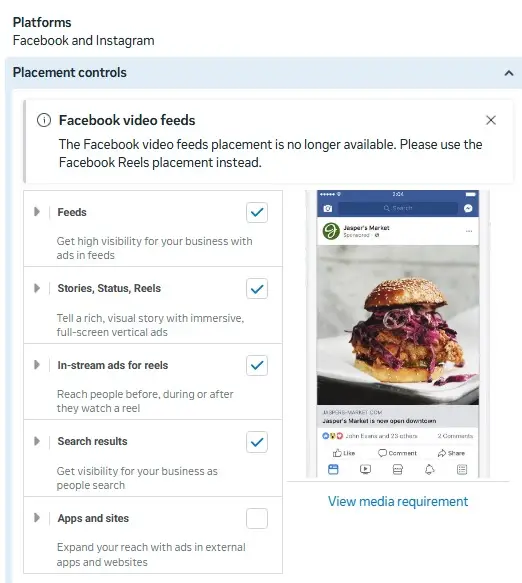
Placing an ad through Facebook allows you to expand that placement to other platforms under the Meta umbrella. Where you choose to place your ad can have a significant impact on your overall Facebook advertising costs. You have the option to place ads on the following platforms:

Facebook News Feed
Facebook News Feed right column
Facebook Messenger
Instagram Feed
Instagram Stories
Meta Audience Network
Meta’s Audience Network includes a wide range of websites and apps within the Meta ecosystem, including WhatsApp. If you choose to place ads through the Audience Network, Facebook allows you to see exactly where your ads are being displayed.
Instagram typically has the highest cost per click (CPC) in India, averaging around ₹60–₹70 per click, while ads placed on the Audience Network cost approximately ₹15–₹20 per click on average.
When placing your ad, you also have the option to enable Automatic Placements, which is a recommended feature. This allows Facebook to show your ad where it believes the best results can be achieved within your budget. You can always disable this feature for greater control, but it is up to you and your team to determine where your ad performs best.
Ad quality has a direct impact on the cost of Facebook advertising, and the platform provides tools to help ensure your ad quality remains high. The general consensus is that the higher your quality score, the lower your CPC.
Facebook evaluates ad quality based on several factors, including overall quality, engagement rate, and expected conversion rate. Overall quality is determined by how relevant your ad is to the selected target audience and how it performs compared to competing ads. Engagement rate measures how many people interacted with your ad compared to how many saw it. The conversion rate is Facebook’s prediction of how likely your ad is to achieve its objective based on your audience and campaign goal.
It is important to note that Facebook only displays a quality score once it has collected sufficient data, usually after 500 or more impressions. The score is also adjusted as the campaign progresses, so it should be reviewed regularly. Once visible, the score will fall into one of the following categories: above average, average, or below average, with further distinctions for the bottom 35%, 20%, or 10% of ads.
To achieve an optimal quality score, ensure your ads are relevant to your audience, use high-quality images and videos, contain correct spelling and grammar, and do not come across as clickbait.
In addition to setting your advertising budget, you also have the option to choose your bidding strategy. The bidding strategy tells Facebook how to bid on your behalf in ad auctions, which is how the platform decides which ad to show to users in your target audience.
The bid amount, predicted engagement probability, and ad quality all influence which ad wins the auction. Facebook offers three core bidding strategies: spend-based bidding, goal-based bidding, and manual bidding.
With a spend-based bidding strategy, Facebook uses your full budget to deliver the highest possible volume or value of conversions. Goal-based bidding allows you to set targets such as cost per conversion or ROAS, although Facebook does not guarantee these targets will be met. Manual bidding lets you set a maximum bid cap, but this limits Facebook’s ability to optimise and should only be used when you have strong historical data.
Facebook displays estimated reach and clicks when you set your bidding strategy. These estimates are based on your chosen strategy, ad quality, and audience data. Monitor your bidding and optimisation reports in Meta Ads Manager to determine whether adjustments are needed, keeping in mind that changes reset the learning phase.
A recent survey conducted by a global digital marketing agency analysed Facebook advertising spend among Indian marketers. Out of the marketers surveyed, the largest group reported spending between ₹8,000 and ₹40,000 per month, while a smaller percentage spent between ₹4,000 and ₹8,000. More than half indicated that Facebook advertising accounts for 0–15% of their total marketing budget.
While these figures offer helpful insight into typical spending patterns in India, they do not tell the complete story. To accurately understand Facebook advertising costs, it is essential to evaluate all key performance metrics, not just the budget.
Average CPC, CPM, and CPA vary by industry, competition, seasonality, and campaign objectives. These benchmarks can be used as guidance when planning your Facebook advertising budget, but actual results may differ significantly.
Once you understand what to expect from a Facebook lead ad campaign, it becomes easier to optimise spend through structured testing, frequency control, and audience expansion. Running A/B tests, managing ad frequency, and creating lookalike audiences are proven methods for improving ROI over time.
While it is possible to identify average Facebook advertising costs based on benchmarks, the actual cost of your campaign may be very different. Costs depend on factors such as your industry, goals, bidding strategy, audience selection, and ad quality.
To accurately understand what your Facebook lead ads will cost and to ensure your budget is used effectively, working with an experienced specialist is essential. ANA Digital Media provides professional Meta Ads management focused on performance, efficiency, and long-term scalability.
By aligning your Facebook advertising costs with your budget, goals, and campaign results, you create a sustainable and profitable paid social strategy.
Facebook advertising costs are not fixed and cannot be measured by a single number. They depend on multiple variables such as your target audience, ad placement, bidding strategy, and overall ad quality. While average benchmarks like CPC or CPM can give you a general idea, the real success of Facebook advertising lies in how efficiently your budget is used to achieve meaningful results. By focusing on relevant targeting, high-quality creatives, and continuous optimisation, businesses can control costs and improve return on ad spend. When managed strategically and backed by data-driven decisions, Facebook advertising becomes not just an expense but a scalable growth channel that delivers consistent and measurable outcomes.


Let our experts turn your goals into real results.
ⓒ Copyright 2026 . All Rights Reserved By ANA Digital Media