Free guide or e-book: A minimum of 40–45%


I hope you enjoy reading this article. If you need support with SEO , Google Ads , Facebook Ads, or Landing Pages, click on the link.
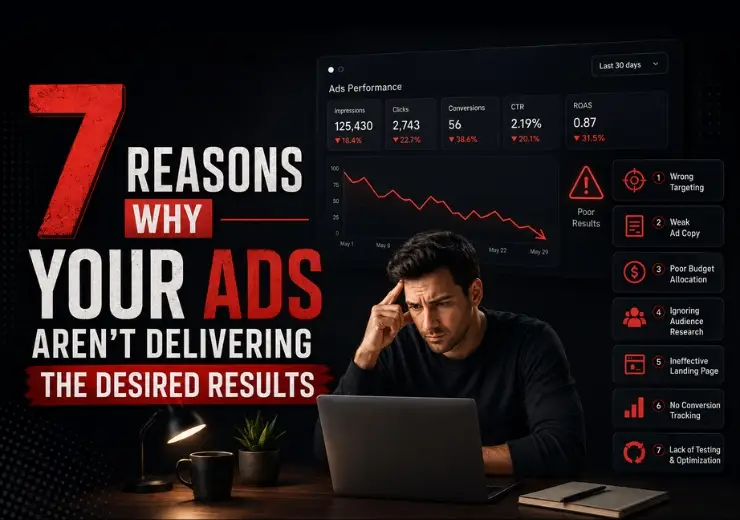
Have you already got advertisements running but find yourself wondering why they are not delivering the results you were hoping for? There can be several reasons behind this, and understanding each one is the first step towards turning things around.
In this article, ANA Digital Media focuses primarily on lead magnet advertisements — think e-books, guides, webinars, free consultations, and similar offers that are used to attract potential customers.
Most of the points covered here can also be applied to your direct sales advertisements, though those typically require a slightly different approach and a little more attention to get right.
Before we dive in, here is one piece of advice to keep in mind from the outset: do not give up too quickly.
When you first start running advertisements, you might expect immediate, impressive results. But nine times out of ten, that is simply not how it works. Be patient, invest time in analysing your data, and commit to continuously optimising your campaigns. The results will follow.
When creating an advertisement, it is important to first ask yourself what the goal of that advertisement actually is. Do you simply want to increase brand awareness, or do you want — in the case of a lead magnet — to generate as many sign-ups as possible?
If you are advertising a free lead magnet or running a direct sales campaign, you should always select "Conversions" as your campaign objective in Meta Ads.
When you choose this objective, Meta optimises your advertisements for that specific goal. If you were to select "Traffic" instead, Meta would show your ad to people who are likely to click — but whether they actually take the desired action is something Meta pays no attention to whatsoever. The result is that your cost per sign-up tends to be significantly higher.
When you select Conversions as your objective, Meta specifically shows your advertisement to people who are most likely to complete the desired action — in this case, signing up for your free lead magnet.
The ideal scenario is to achieve a minimum of 50 conversions per week per audience. This allows the Meta algorithm to exit the learning phase as quickly as possible and begin optimising your campaign more effectively.
Meta does not always display conversion numbers with complete accuracy. It is therefore important to review your results more broadly — not just within Meta Ads Manager. For example, you can tag sign-ups coming through Meta Ads with a unique label in your email marketing platform, such as ActiveCampaign, so that you can track them independently and get a more accurate picture of your actual results.

Never underestimate the importance of the audience you set for your advertisements. Your audience targeting has an enormous impact on the results of your campaigns. You have likely already created a customer profile or buyer persona at some point — now is the time to translate that into a targeted audience within Meta Ads.
Age Do not be too restrictive. If your typical audience falls between the ages of 28 and 35, consider broadening your targeting to between 25 and 40, for example. This can sometimes yield surprisingly strong results by capturing a wider pool of relevant people.
Gender Select the gender or genders that are most relevant to your specific offering and audience.
Location Are you targeting customers across India as a whole? Then select India as your location. Alternatively, you can target specific states or cities — for example, focusing on metro cities such as Mumbai, Delhi, Bangalore, Hyderabad, Chennai, and Pune, or targeting Tier 2 cities such as Jaipur, Lucknow, or Ahmedabad if that better reflects your customer base.
Interests and Behaviour This element often requires some exploration, as not everything is available as a targeting option, and Meta periodically removes or adjusts certain targeting parameters. Search for relevant keywords related to your niche and take note of the suggested interests that Meta surfaces alongside your search terms.
It is also possible to create Custom Audiences and Lookalike Audiences. Custom Audiences are built based on your website visitors, engagement on Facebook and Instagram, your existing mailing list, or your current customer database. Lookalike Audiences are created based on your Custom Audiences and are often extremely valuable — because Meta can identify exactly what interests, behaviours, and online habits your existing customers share, and then find new people who match that profile closely.
In the Indian market, where consumer behaviour and preferences can vary significantly across regions, languages, and demographics, audience segmentation is particularly important and can have an outsized impact on your campaign performance.
The average person in India scrolls through an enormous volume of content on social media every single day — across WhatsApp, Instagram, Facebook, and YouTube. In this highly competitive environment, it is absolutely critical that your advertisement stands out immediately and that your target audience feels directly spoken to. Tap into their specific needs and demonstrate clearly that your offer is exactly what they have been looking for. Think creatively, avoid doing what every competitor is already doing, and dare to stand out.
Start your copy with a question or a bold statement that immediately grabs attention or sparks curiosity. In the Indian context, addressing a very specific and relatable pain point — whether it relates to business growth, income, health, education, or career — can be highly effective.
Test both short-form and long-form copy, as preferences can vary significantly depending on the audience. What works well for a business owner in Mumbai may differ from what resonates with a working professional in Chandigarh.
Choose an image or video that complements and reinforces your copy, and that stands out distinctly from everything else appearing in the Instagram or Facebook feed. Interestingly, less polished, more authentic-looking visuals often outperform highly produced, corporate-looking creative — particularly in the Indian market, where authenticity and relatability tend to build stronger trust.
Test with different copy and creative combinations to discover which variants perform best for your specific audience. Never assume — always let the data guide your decisions.
Consider using dynamic advertisements, where Meta automatically tests which combinations of images and copy perform best for your audience. Keep in mind that likes and comments become less visible when dynamic creative is in use, due to the large number of possible variations.
Switch off underperforming images or copy variants, and create new variations based on your best-performing elements. Iteration is key to long-term advertising success.
Would you like to know which proven persuasion and neuromarketing techniques you can apply to convince potential leads and customers in India to sign up or make a purchase? Get in touch with ANA Digital Media to find out how we can help you create high-converting advertisements.

Are you noticing that plenty of people are clicking on your advertisements, but that too few of those clicks are actually converting into sign-ups? And as a result, your cost per sign-up is higher than you would like? This is most likely related to your landing page.
The first step is to calculate your conversion rate, using the following calculation:
Number of actual sign-ups ÷ Number of people who clicked through to the landing page × 100
Example: 30 sign-ups ÷ 150 clicks to the landing page × 100 = 20%
If that figure does not mean much to you yet, here are the general benchmarks that ANA Digital Media uses as a starting point:

Free guide or e-book: A minimum of 40–45%
Webinar: A minimum of 30–35%
Challenge or workshop: A minimum of 25–30%
If you are falling below these benchmarks, it is important to optimise your landing page.
The most critical factor is that your landing page aligns closely with your advertisement. The visual style, imagery, and tone of your advertisement should be consistent with what visitors see when they arrive on the landing page. Any disconnect between the two creates doubt and increases the likelihood of visitors leaving without converting.
Additionally, make sure the sign-up form is visible immediately — without requiring the visitor to scroll. The more effort required to find the form, the higher the drop-off rate. Every extra step or moment of friction reduces your conversion rate.
Consider adding reviews or testimonials about your free lead magnet to provide additional social proof and reassurance. In India, peer recommendations and social proof carry particular weight — so even a few genuine testimonials can make a meaningful difference.
Also minimise distractions on the page. Remove or reduce the navigation menu so that visitors are not tempted to click away to other parts of your website before they have completed the sign-up.
Want to learn more about improving your landing page for more conversions? Visit our dedicated landing page to find out how ANA Digital Media can help.
It is often very difficult to determine in advance which headline, copy, call to action, image, or landing page will resonate most strongly with your target audience. Furthermore, over time, your ad frequency will naturally increase as the same people within your audience see your advertisement repeatedly. It is therefore essential to keep optimising and testing your campaigns, making changes over time to ensure your advertisements continue to perform well.
When testing, always change only one element at a time. If you change multiple things simultaneously, you will not be able to determine which specific change caused the improvement or decline in results. Start, for example, by testing two different images. Once you know which image resonates best with your audience, you can move on to testing two different versions of your copy — and so on. By continuing to optimise in this methodical, step-by-step way, you will build an increasingly accurate understanding of what speaks to your audience.
More budget generally allows for more variations to be tested simultaneously, which can accelerate the learning process.
An important note: if an advertisement is performing exceptionally well, resist the temptation to keep making adjustments in search of even better results. Every time you make a significant change to a well-performing advertisement, it re-enters the learning phase, which can actually have a negative impact on results in the short term. If you still want to test new ideas, create a separate campaign for that purpose, targeting a different audience. Otherwise, you risk competing against yourself within Meta's auction system.
When someone downloads your free lead magnet, they should ideally be directed to a thank you page. This thank you page serves two important purposes: it allows you to track conversions accurately, and it gives you an immediate opportunity to present an offer to someone who is already engaged and interested.
At this moment, the person has already demonstrated interest in what you offer — which means they are far more receptive to a follow-up offer than a cold visitor would be. This is a valuable window of opportunity that many businesses in India overlook entirely.
Consider creating a sense of urgency on the thank you page if it is appropriate for your brand and offer — but be authentic about it. Audiences today are savvy and will see through artificial scarcity or pressure tactics quickly.
If you would prefer not to make a direct product offer immediately, you can instead direct people to a relevant masterclass, a short introductory video, or an invitation to book a free discovery call. People typically do not expect to receive anything additional beyond the lead magnet they signed up for — which means that when you do offer something of genuine value at this stage, the psychological effect of reciprocity can be quite powerful. The desire to give something back — by making a purchase or booking a session — naturally increases.
This is a particularly effective strategy for service-based businesses, coaches, consultants, and digital agencies operating in India — where relationship-building and demonstrating value before asking for a sale is an especially important part of the buying process.
If you are running an advertisement for a free lead magnet, it is essential that your email funnel — the sequence of emails that follows the initial sign-up — is properly set up and optimised. If you only send the free lead magnet itself and nothing else, the likelihood of recipients taking further action afterwards is significantly lower.
It helps enormously to send a series of well-crafted follow-up emails after the initial delivery of the lead magnet, and to continuously optimise those emails based on performance data.
Is almost nobody opening a specific email in your sequence? Then try adjusting the subject line — this is the single biggest factor influencing open rates. Is nobody clicking through once they have opened the email? Try incorporating a clearly designed button rather than a plain text link, as buttons tend to attract more clicks and are easier to tap on mobile devices — which is where the majority of Indian email recipients will be reading your messages.
This is where marketing automation becomes invaluable. By setting up automated email sequences that are triggered by specific subscriber behaviours, you can nurture leads intelligently over time — building trust, delivering value, and guiding prospects towards a purchase without requiring constant manual effort.
Important: Always ensure you have obtained proper consent from subscribers before sending them a series of marketing emails, in compliance with applicable data protection regulations in India.
If after reading this article, you still feel you could use some expert guidance, ANA Digital Media is here to help. Our team has hands-on experience helping Indian businesses generate more leads and sales from their Meta Ads, Google Ads, and overall digital marketing strategy.
Whether you need support with your landing pages, your SEO, your graphic design, or your paid advertising campaigns, we can help you build a strategy that delivers real, measurable results.
Book a free strategy consultation with ANA Digital Media today and let us help you get more from every rupee you invest in your marketing.


Let our experts turn your goals into real results.
ⓒ Copyright 2026 . All Rights Reserved By ANA Digital Media